

The Executive’s Guide to Being on Camera
A Media Training Guide on how to Speak Naturally on Camera
Speaking on camera is an art. We've worked with a ton of keynote speakers who have no problem talking to a room of 200 people but completely freeze in front of a camera. Because cameras cannot provide the back-and-forth energy that a physical audience radiates, speaker strategy has to be slightly different. While it can seem daunting, finding your voice on camera is easy with just a little bit of practice. Keep reading for our top tips on executive media training for video.
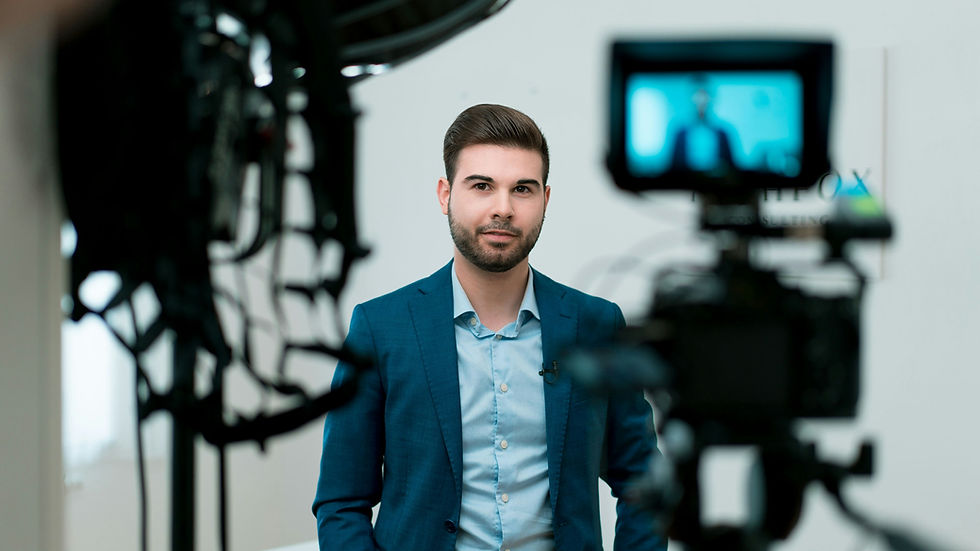
1) Practice Your Presence
As an executive, you know how important it is to present yourself as professional, knowledgable, and personable. However, even the most competent and approachable execs can come across as aloof and stiff without prepping for the camera first. Because repetition is the key to learning any new skill, the more you're on camera, the more visibly comfortable you'll be. Practice sessions don't have to be elaborate. Have someone set up a camera (a phone will do) and ask you any questions they'd like. Remember, this repetition is not about the content of what you're saying; it's about speaking naturally to a camera. Practice questions could include anything from "How's the weather?" to "What's your favorite movie?"--as long as you look into the camera to answer them, they're perfect. After the session, watch the video back: Did any awkwardness you felt while filming get picked up on camera? What went well? We suggest doing multiple practice sessions. The more you do it, the less it feels like a novelty, boosting your confidence.
2) Practice Your Delivery
Even in a conversational interview, speaking on camera is a bit different from talking to someone in realtime. For instance, we recommend answering every question in a complete sentence, referencing the question if possible. While this would be an awkward, clunky way to converse with someone, it allows soundbites to stand on their own. For example: “What services do you offer?” “Angela Wolf Videos offers a variety of high-impact video solutions for midsize businesses.” Now the video editor can remove the question and the answer is a soundbite that stands on its own. When practicing speaking on camera, you'll also need to boost your energy level by about 20%. While you don't need to be as animated as you would be on stage, it's crucial to give more than if you were talking 1:1 with someone. Lastly, remember to smile. This is the number one tip we tell clients when filming corporate video presentations. Interviewees are often so focused on providing a solid answer to the question that they look agitated or angry. Taking a big breath and speaking with a slight smile helps soften your delivery.
3) Practice Your Message
You are an expert in your field--that's why your presenting on camera. However, speaking naturally on camera relies on not just knowledge of the material, but also clear communication of your corporate video's message. It's easy to get bogged down with the nitty gritty of your talking points. However, it's not conducive to a smooth delivery that holds the attention of viewers. For example, when making a video for our business, we could easily talk about ISO, frame rates, and bitrate. However, that doesn't speak to our audience. Instead, focus on client experience, considering how a potential client may connect with your video. Rather than diving into our video expertise, we would share relevant information that drives our message home, such as the fact that 84% of video marketers report that video has directly increased sales. When practicing your message, review both the talking points and the overall purpose of the video. This demonstrates that you are dedicated not only to finding solutions, but also to highlighting the client experience and your corporate values.
Angela Wolf Video offers corporate video production services near Philadelphia, PA.
Do you have a specific video question? Schedule a free video analysis call at bit.ly/callawv


